
Time Release
Brandel France de Bravo
1.
There will be a last poet, but not a last poem. The moon
may have to remain nameless forever like lover or wife.
God isn’t dead. They’ve transitioned and are living unhoused.
If every word was once a poem, then every object, experience,
phenomenon deserves an elegy, thinks the last poet, whose
death mask won’t be made. You’ll know it’s a revolution
‘cause there won’t be no commercials, rapped the Last Poets
over congas in 1970. When the revolution, asteroid, Rapture,
floods come, who will write psithurism, apricity, or petrichor?
Even if it’s scraped from the internet, that barnacle-covered ship
swallowing the seven seas, even if no one sighs audibly in unison
at the last line, poems will still exist. Ice chased by lust escaping
into water, the moon going through the change, inching away
from its partner to slow-quit the pedestal, bow out of the dance.
2.
No way to slow-quit his pedestal, bow out of the dance.
“Sol,” 460 kgs., turns away from the matador to stand
at the stained door from which he emerged. An egg
that’s been laid can’t go back inside the bird. Next up,
“Tricolor,” and thousands more bred for their one fight.
Ring by ring, protests lead to bans, which are protested,
lifted, reinstated. Wearing a suit of lights and pink tights,
the last bullfighter walks into the arena, pelvis leading.
In dust that smells of wineskins and severed ears, he kneels
before the bull, holding his red cape to one side, sword
inside: a formal invitation. The bull flips the cape up—flap
of an envelope—and passes under. A pivot and the partners
face each other again. Whether conjoined by blade or horns,
only the man will conflate a dying art and the art of dying.
3.
This man who conflates a dying art, and the art of dying,
dressing, stretching, stitching pelts, knows from suffering.
It’s epigenetic: the story on top of the story. He sees
pogroms through the eye of his needle and a sheared child
in every client. Who wouldn’t want a sable body guard,
esteem you can run your fingers through wherever you
have to run? Today’s spurned furs can be blankets, he says,
can sponge up oil spills, dissolving into the ocean after,
no micro fibers or particles left behind. The synthetic origin
of a Hassid’s fur hat harkens back to a time Jews had to
wear tails. When the minks became sick, had to be culled,
we learned how much a mink can carry. With receptors
that bind to both bird and human flu, they’re “mixing bowls”
like bats. Or like minds that can hold two opposing ideas.
4.
Like bats or like minds that hold two opposing ideas,
postcards flapped and swooped over land and ocean
to roost in dark pouches, metal mailboxes, waking up
to feed, Chiroptera, hands with wings, the only creature
that flies and nurses its young. Do you remember
your thirst? You’d glance at the postcard’s palm trees,
Paul Bunyan statue, before turning it over to drink in
the block print or tipsy cursive, which if familiar,
conveyed the sender as much as gold-specked irises,
a nasal voice. Now, his words, yours, autocomplete
in the same smearless san serif, pass through underwater
cables, untouched, lick lacking. Among the bric-a-brac,
Tiffany lamps, is a boxful of strangers’ postcards: cast
your flashlight on hematite horses, inert ochre hands.
5.
Flashlight on hematite horses, inert ochre hands, you flash
forward to back in the day, street-corner caves, their metal
and plastic walls tagged in spray paint, Sharpie, and blood,
where you pleaded into a receiver, or before inbound calls
were eliminated, waited. The dial tone was a coin toss:
possibility heads, sad-as-fuck tails. Your boyfriend didn’t
believe your lie—I’m NOT high—and hung up. Untappable
without a warrant, they let you connect with your connection,
keep dry while killing time, both a sentence and a crime.
To snitch is to “drop a dime.” Payphones got redlined: barred
outside liquor stores, public housing, then by town charters.
New York ripped out its last in 2022. Nostalgic? Go to prison.
No one there needs wikiHow to use one. An inmate’s call is
time limited, and if you happen to miss it, it can’t be returned.
6.
Time’s limited, and if you happen to miss it, there’s no return.
What is a last exit? After my daughter was born, I cried out
to no one, I’m on an expressway, and I can’t get off! You know
the trope about the frog: heat the water slowly, and it won’t
jump out. Humans are stupid like that—they maladapt. You’re
red as a lobster! my mother liked to exclaim, meaning the color
of boiled alive. They don’t feel any pain, the adults at the beach
house said, but I needed no reassurance. I watched with relief
as the lobsters were lowered into the pot, putting an end to cold
horror: opening the fridge to a shelfful of caper eyes, listless
antennae below my milk and chocolate pudding. At the last boil,
one lobster will clamber over, climb on top of all the others,
a shipwreck survivor on Gericault’s raft, one claw raised. And,
we’ll be melting butter, adrift, but drawing closer to shore.
7.
Melting like butter, adrift but drawing closer to shore,
a woman lies at the bottom of a pirogue. She’s looking
up at the loud sun, her arms crossed. If she had an oar,
she’d row on this side, that side, in the direction she has
no word for. She wishes she’d taught her language
to her children who talk like motor boats with yes’s
and no’s that speed up, cut off their speech. All choke
and none of her soft ripple. She is a wake of one.
On the island, will she find boxes with leaves inside?
A man showed her one, told her that was where her
language would sleep once she was gone. She murmurs
the words she used to sing to wake her children. With one
ending we begin. Good day, says the sun. Goodbye, says
the moon. Let there be a last poet, but not a last poem.
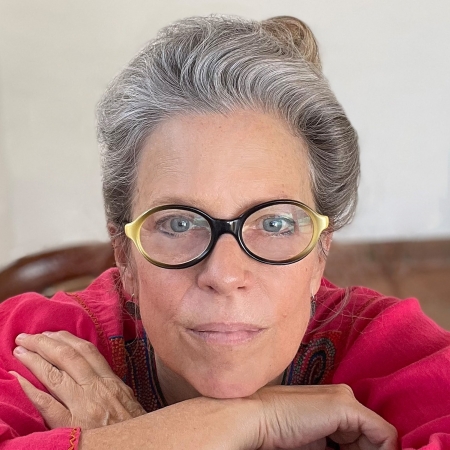
Brandel France de Bravo’s most recent book of poems is Locomotive Cathedral (Backwaters/University of Nebraska Press). Her poems have recently appeared in Best American Poetry, 32 Poems, The Cincinnati Review, The Southern Review and elsewhere. She has received fellowships from the DC Commission for the Arts, the Hermitage Artist Retreat and the Virginia Center for the Creative Arts. www.brandelfrancedebravo.com
Table of Contents for A Formal Feeling