
Corresponding Authors (Letter 7 of 9)
In response to:
30 May 2017
Dear Anthony,
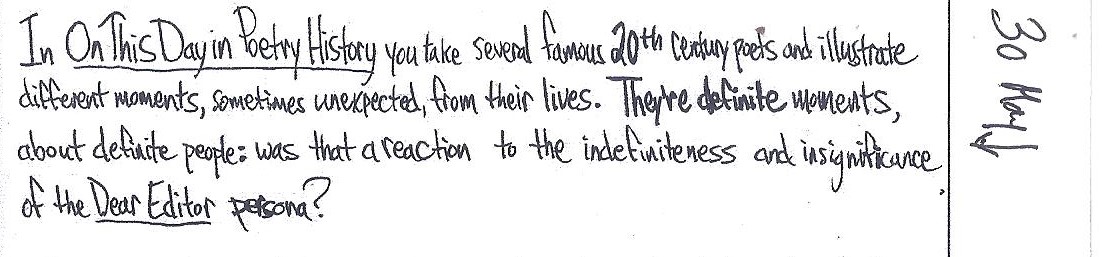
I had not considered this, but you are onto something. On This Day in Poetry History grew out of Dear Editor, certainly. As I wrote in an earlier letter, I had thought that by trying to allow the wandering poetry mind to permeate the boundaries of a cover letter (within which the poetry mind would not ordinarily wander), I might locate something about poetry, isolate the essence in some way. But every book is about its inability, finally, to get all the way to where it wished to go, and after finishing Dear Editor, I was still interested in how poetry happens.
I was reading a biography of a poet for a class I was planning to teach, and I thought: What if I can find the moment in a poet’s life when s/he becomes a poet? Would I, reading the life of Elizabeth Bishop, say, find that moment when her mind turned toward poetry, like a heliotrope is said to turn to the sun? (for love, it’s said, for Apollo.) Or did John Berryman, dismayed and tired, walking the streets to sell encyclopedias, pass though through a kind of wall into his future? (moving from one John Berryman to Berryman the poet.) Those kinds of questions obsessed me. It was a great relief to be out of my own head and into the hard facts of biography and real lives and real poets. The details and the material of their lives were wonderfully grounding, and I did not know it enough to recognize it then but am convinced now by your question that the history and facts of it all were beautiful tome by virtue of that groundedness. (is that a word? by virtue of their being grounded.)
And yet on the other hand, one element that delighted me was this: studying these famous poets, I came to see them differently. We know them by reputation through the lens of their greatness; they are kind of poetry gods who became divine through their work which (these poets in particular) was a byproduct of their lives. And we tend, or I certainly did tend, to see them in this practically mythic light. They achieved myth, they evolved into their greatness, and so we see them in apotheosis. We see them glorified. Reading their letters, materials, their journals, biographies, etc., I choose to isolate not the famous moments but the seemingly trivial—Lowell dropping his eyeglasses out of a window to watch them fall, Sexton watching the birds at her feeder, or tucking a red nightie into her handbag on the way to her therapist’s office because she’s having an affair with him. I came to see Plath, Berryman, Roethke, Lowell, Sexton, Bishop, Schwartz, as so human, as people rather than as poets to be studied. This was so valuable, to understand these writers not an unapproachable myths, but as human.
Amy
Back ← ♦ → Next letter