
Corresponding Authors (Letter 6 of 9)
In response to:
28 May 2017
Dear Anthony,
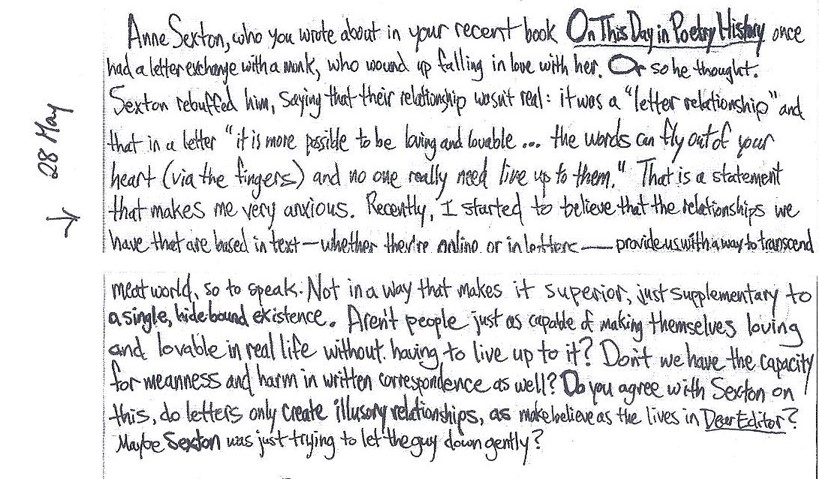
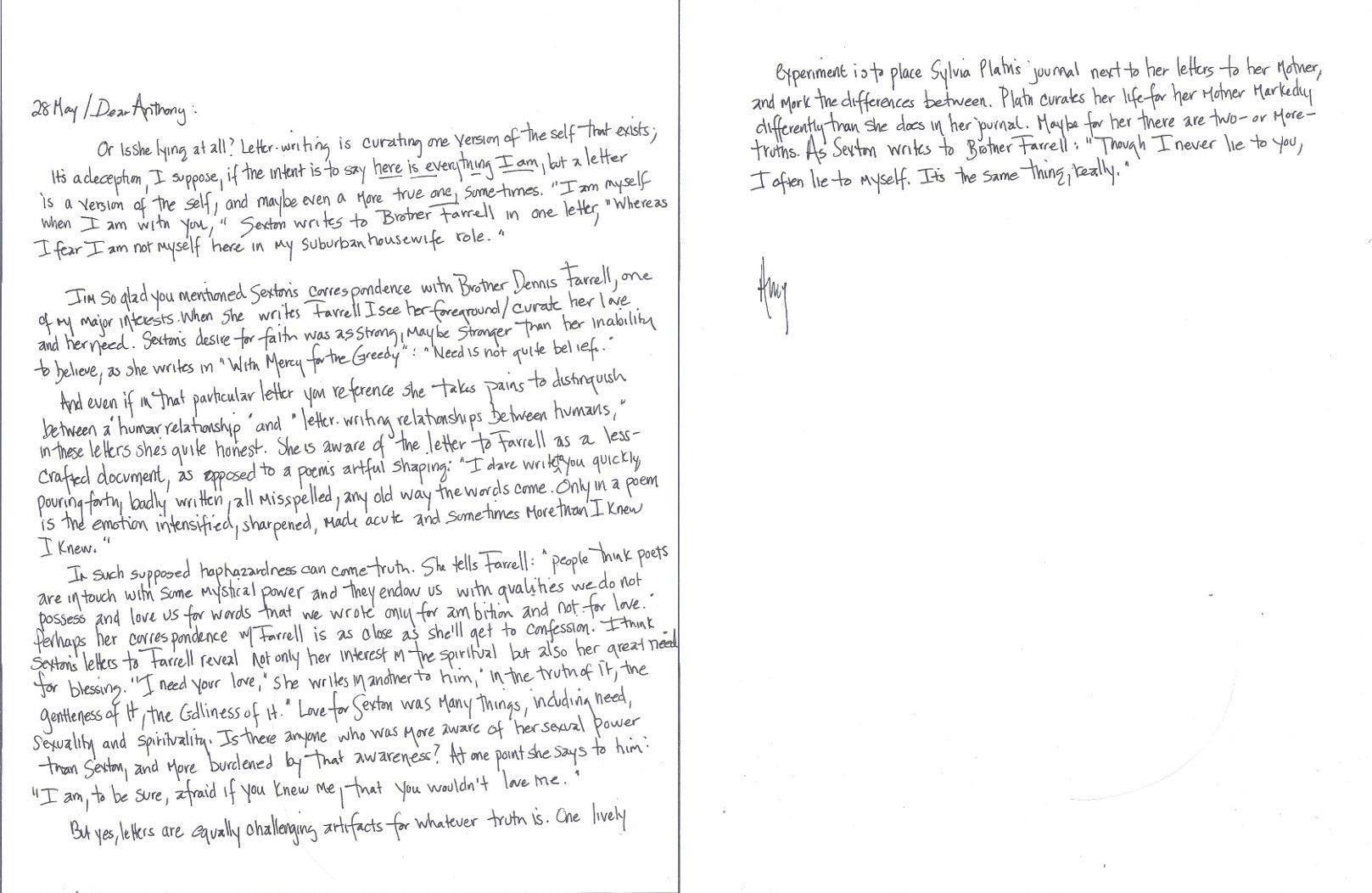
Or is she lying at all? Letter-writing is curating one version of the self that exists; it’s a deception, I suppose, if the intent is to say here is everything I am, but a letter is a version of the self, and maybe an even more true one, sometimes. “I am myself when I am with you,” Sexton writes to Brother Farrell in one letter, “whereas I fear I am not myself here in my suburban housewife role.”
I’m so glad you mentioned Sexton’s correspondence with Brother Dennis Farrell, one of my major interests. When she writes Farrell I see her foreground/curate her love and her need. Sexton’s desire for faith was as strong, maybe stronger than her inability to believe, as she writes in “With Mercy for the Greedy”: Need is not quite belief.
And even if in that particular letter you reference she takes pains to distinguish between a “human relationship” and “letter-writing relationships between humans,” in these letters she’s quite honest. She is aware of the letter to Farrell as a less-crafted document, as opposed to a poem’s artful shaping: “I dare write to you quickly, pouring forth, badly written, all misspelled, any old way the words come. Only in a poem is the emotion intensified, sharpened, made acute and sometimes more than I knew I knew.”
In such supposed haphazardness can come truth. She tells Farrell: “people think poets are in touch with some mystical power and they endow us with qualities we do not possess and love us for words that we only wrote for ambition and not for love.” Perhaps her correspondence w/ Farrell is as close as she’ll get to confession. I think Sexton’s letters to Farrell reveal not only her interest in the spiritual but also her great need for blessing. “I need your love,” she writes in another to him, “in the truth of it, the gentleness of it, the G-dliness of it.” Love for Sexton was many things, including need, sexuality and spirituality. Is there anyone who was more aware of her sexual power than Sexton, and more burdened by that awareness? At one point she says to him: “I am, to be sure, afraid if you knew me, that you wouldn’t love me.”
But yes, letters are equally challenging artifacts for whatever truth is. One lively experiment is to place Sylvia Plath’s journal next to her letters to her mother, and mark the differences between. Plath curates her life for her mother markedly differently than she does in her journal. Maybe for her there are two—or more—truths. As Sexton writes to Brother Farrell: “Though I never lie to you, I often lie to myself. It’s the same thing, really.”
Amy