
Corresponding Authors (Letter 5 of 9)
In response to:
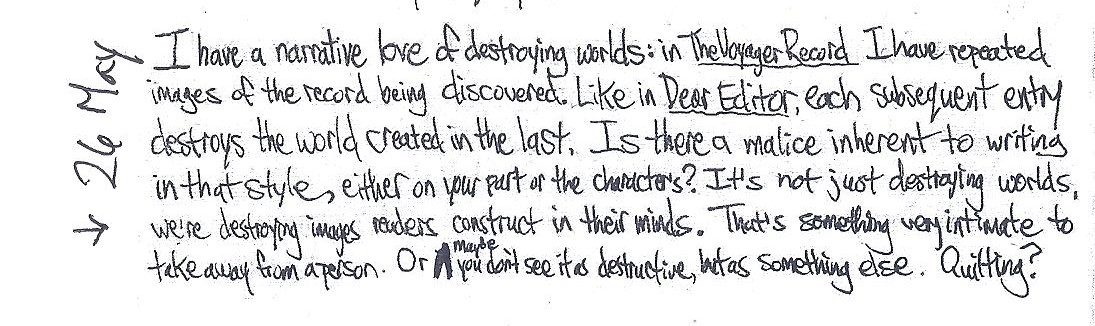
26 May 2017
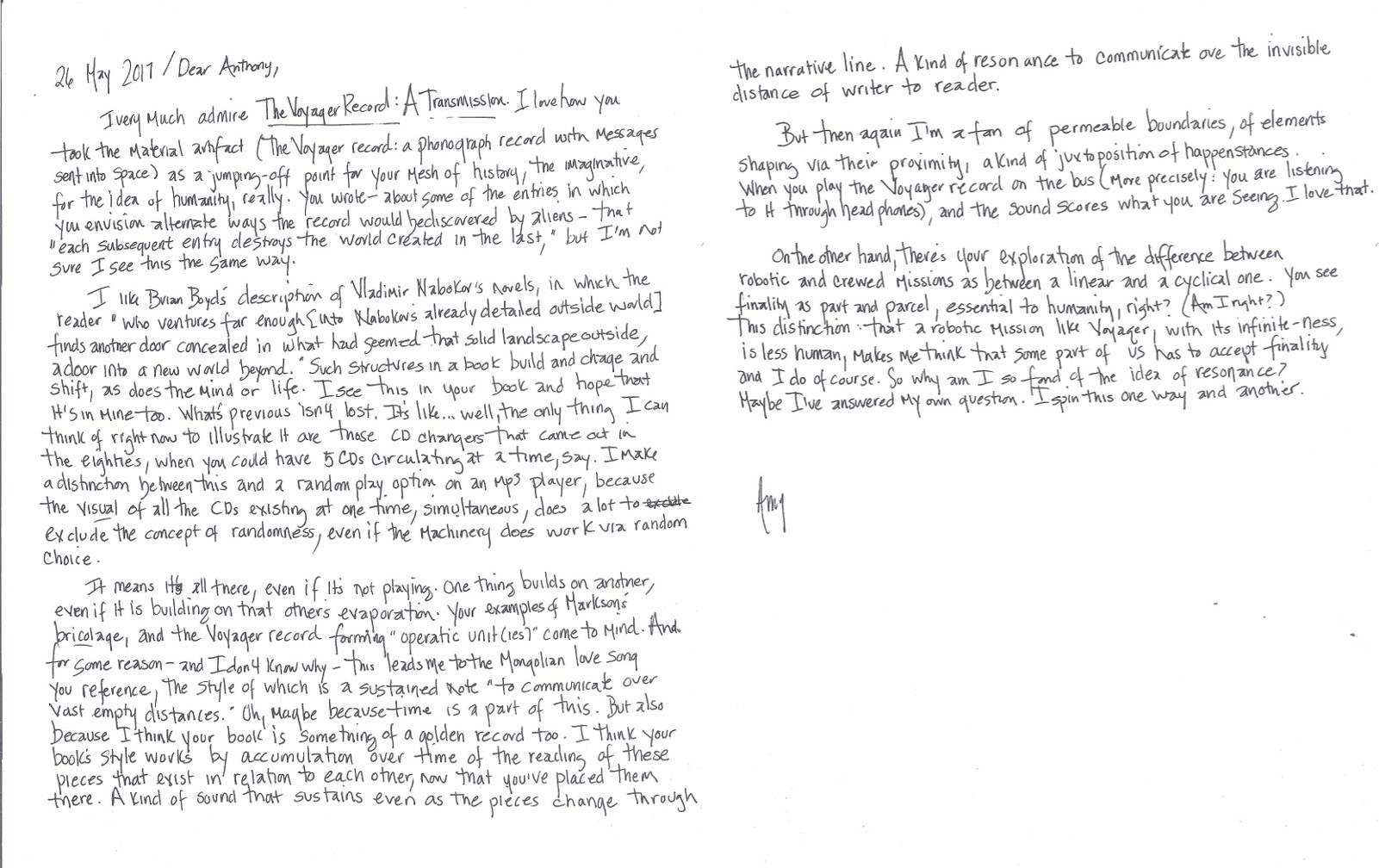
Dear Anthony,
I very much admire The Voyager Record: A Transmission! I love how you took the material artifact (The Voyager record, a phonograph record with messages sent into space) as a jumping-off point for your mesh of history, the imaginative, for the idea of humanity, really. You wrote—about some of the entries in which you envision alternate ways the record would be discovered by aliens)—that “each subsequent entry destroys the world created in the last,” but I’m not sure I see this the same way.
I like Brian Boyd’s description of Vladimir Nabokov’s novels, in which the reader “who ventures far enough [into Nabokov’s already detailed outside world] finds another door concealed in what had seemed that solid landscape outside, a door into a new world beyond.” Such structures in a book build and change and shift, as does the mind or life. I see this in your book and hope that it’s in mine, too. What’s previous isn’t lost. It’s like…well, the only thing I can think of right now to illustrate it are those CD changers that came out in the eighties, when you could have 5 CDs circulating at a time, say. I make a distinction between this and a random play option on an mp3 player, because the visual of all the CDs existing at one time, simultaneous, does a lot to exclude the concept of randomness, even if the machinery does work via random choice.
It means it’s all there, even if it’s not playing. One thing builds on another, even if it is building on that other’s evaporation. Your example of Markson’s bricolage, and the Voyager Record forming “operatic unit[ies]” come to mind. And for some reason—and I don’t know why— this leads me to the Mongolian love song you reference, the style of which is a sustained note “to communicate over vast empty distances.” Oh, maybe because time is a part of this. But also because I think your book is something of a golden record too. I think your book’s style works by accumulation over time of the reading of these pieces that exist in relation to each other, now that you’ve placed them there. A kind of sound that sustains even as the pieces change through the narrative line. A kind of resonance to communicate over the invisible distance of writer to reader.
But then again I’m a fan of permeable boundaries, of elements shaping via their proximity, a kind of juxtaposition of happenstances. When you play the Voyager Record on the bus (more precisely: you are listening to it through headphones), and the sounds score what you are seeing. I love that.
On the other hand, there’s your exploration of the difference between robotic and crewed missions as between a linear narrative and a cyclical one. You see finality as part and parcel, essential, to humanity, right? (Am I right?) This distinction: that a robotic mission like Voyager, with its infinite-ness, is less human, makes me think that some part of us has to accept finality, and I do of course. So why I am so fond of the idea of resonance? Maybe I’ve answered my own question. I spin this one way and another.
Amy