
The Fault
After a full year in the nursing home, my mother’s fingers have got spindly. “I’m wasting away!” she cries. “Look at this, my ring jounces. It skips.” We are sitting in her room at the nursing home, she in her wheelchair, me in the bedside chair I’ve denuded of newspapers and books and pieces of cardboard and used napkins and dried-up markers. The nursing home always smells of pungent solvents and urine, but her room smells worse than that. She has a habit of removing her adult diapers while she lies in bed and leaving them balled up at its foot.
“Let me get the ring resized for you,” I say, ever the solver. “Or try it on your right hand or on another finger, it might fit better.” Advice infuriates her. My kneejerk is always to deal with the practical over the underlying.
“No, no,” she shakes her head, cheeks sagging, suddenly wet with tears. “It’s my last, the last, my only possession. Here,” she says, and she pulls the ring from her finger and presses it into my hand.
“No,” I say.
“Thieves are everywhere.” She jerks her head at the curtain that divides us from a bedbound roommate. “Take it.”
Despite their thinness, her fingers feel as warm and strong as ever, the ring balanced between us, her fingers, my palm. I feel the moment, but my job is to dampen, to tamper down. I say no, generally, to anything my mother offers, any gambit, any gift. Just yesterday, she’d called me up wanting to borrow a table saw. The week before, she asked me to send out slides of her artwork to gallery owners, speaking over me as I explained that nobody deals in slides anymore. But this day, the day of her ring, is my birthday. Typical August, it is unbearably humid and bright. I’d slid a reflective lens between my dashboard and the windshield of my car so the plastic wouldn’t get sticky, melty, in the unshaded parking lot. “It’s yours now,” she says.
There is a flaw in the gemstone. I can see in the amethyst’s left-hand quadrant a smudge, a cataract in the facet. The rest of the stone is a clear purple. The silver of the setting has been battered, even gouged, and a prong fixing the gemstone in place was bent, paint-spattered – inevitably, since my mother was always hammering nails into stretcher bars and nails into walls.
She never took that ring off, not for years, no matter what she was painting or stapling or gluing or dyeing or throwing.
Over the last decade, I have rudely refused bites of the many ice creams cones she’s offered me — she loves ice cream — and sips of her ever-present Cokes. I’ve grown to dislike the scent of the geraniums I buy for her, flowers she loves, and to despise the color of poinsettias, her usual Christmas haul. But what, I wonder, should I do about this amethyst ring?
I slip it on a finger of my left hand. Under the fluorescent lights, the flaw in the stone is the greyish undertone in my mother’s paintings, a beautiful color discolored, silenced. I lift my hand to the window so that I can see the ring at arm’s length, a silhouetted, solitary stone in a harsh sunlight. Yes, the ring is a perfect fit.
My mother watches me in silence.
Note. This piece was written after reading Robert Frost’s “A Minor Key” in an anthology of poems about birds. Frost can be complicated to follow; his lines twist about, advancing one thought, undermining that thought in the next breath. “A Minor Key” is uncommonly straightforward. The poem is short: four stanzas of rhymed couplets. He says he dislikes the strident repetitive call of the common ovenbird, a brown bird with a speckled breast. He claps his hands at it, shooing it away, but he wonders at himself: “there must be something wrong / in wanting to silence any song.” My piece began as a piece about disliking poinsettias and geraniums and why the fault for that lay in me. As I explored my “clap” against flowers, it evolved into a scene between a mother and daughter and a particularly fraught transaction that represents other emotional transactions. As I wrote, I stole a few nouns from Frost’s poem, but they pruned away in revision, leaving only “silence.”
Drapes
Many people said my grandmother was prim, even prissy. Maybe you’d have agreed, but even now, when I pull a tissue seat cover from a big envelope mounted on the wall of the ladies room, I am following her advice. “A lady must, particularly in gas stations…well!” she would say and nod once, twice, her eyes earnest as a squirrel’s. I tear the tissue into wings — you can’t help but tear them – and wonder, Why have I never explained to my daughters the dangers of toilet seats? I have conveyed my grandmother’s advice about spitting in the street, picking your teeth with a match book cover, and blowing your nose at the table. This advice is generally ignored, but probably not by well-brought-up you. You might even agree with my mother-in-law who said one day: “We never say ‘gift’ or ‘drapes’ or ‘home.’”
“Why not?” I ask.
“Because it’s common,” she says, but she says it this way: cocomum — a strange pig-Latin for a word “we” must not say at all.
“What’s common about drapes?” I ask.
And she says, “People who say drapes buy their own furniture.”
“Where else would you get furniture?” I whisper to my husband. This is years ago and we are sitting in my in-law’s living room, a young, newly-married couple. “You inherit it,” he says and I see that all of my mother-in-law’s furniture is dark with age and obviously re-upholstered. Forest green corduroy on an armchair, striped duck on a sofa, and throw pillows salvaged from threadbare Turkish rugs.
“Not cocomum,” I say to myself, “just shabby.” It’s a lesson. And to consider it further I pull from my pocket a stick of Juicy Fruit, slip it free of its silvery sheath, and pop it in my mouth. I chew the way a lady does, of course, the way you’d chew gum. With my mouth closed.
Note. I wrote this little piece after seeing Meret Oppenheim’s “Object” at MOMA. “Object” is a sculpture of a tea cup, saucer, and teaspoon covered in fur. I had seen the piece before but I hadn’t realized that Oppenheim was a woman, and, as I’d been reading Barbara Pym’s very British novels of post-war tea parties and feminine frustration, I now saw the sculpture differently. Could this grouping, demure even in its furriness, represent a decorous, rules-bound, and yet savage femininity? This question led me to consider – and embroider – some of my own lessons in social arbitrage.
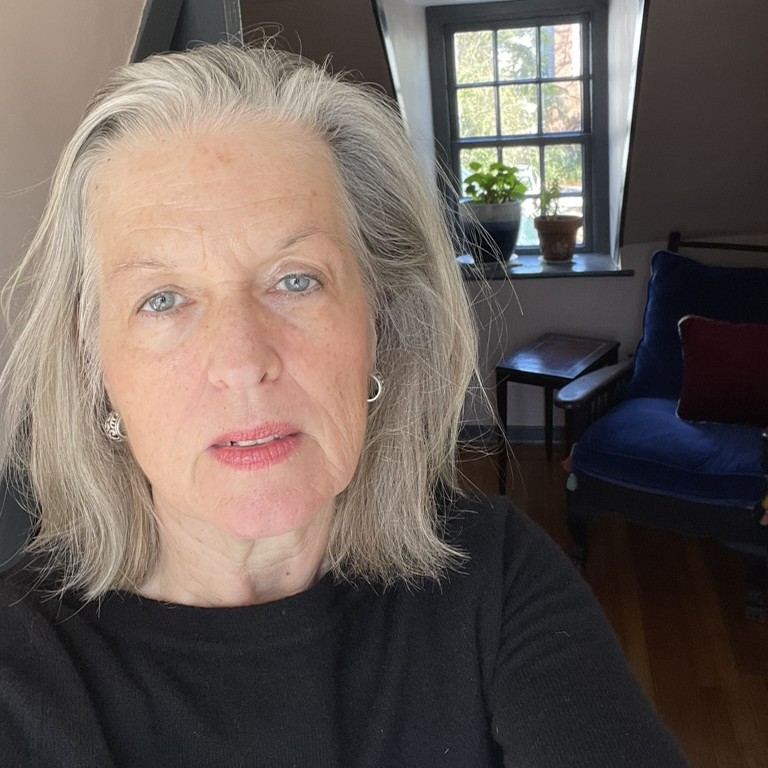
Celia Bland’s poetry and essays have appeared in The American Poetry Review, Plume, Witness, Yellow Medicine, The Southern Humanities Review, and Fence, among other venues. She co-edited Jane Cooper, A Radiance of Attention (Michigan). Her third collection of poetry, Cherokee Road Kill, appeared in 2018, and the title poem won the Reynes Prize. She is currently co-editing A Jar of Air, a collection of essays on the work of Maxine Chernoff (MadHat). She was writer-in-residence in poetry at Bard College for two decades and lives on the Eastern Shore of Virginia.