
Dana Kurskaya (Russia)
Translated by Olga Zvyeryeva (Netherlands)
Please be silent, I ask you, let nobody know
that I am a tree, a tree that heard the war.
I couldn’t prevent it, I could do nothing right,
my broken branches probed into the night,
my graying leaves merely murmured in vain
a piteous melody clotted with pain.
An overgrown path will someday lead you to me,
you will listen to birds nesting so deep,
deep in the pitch-black bottom of my darkest hollow;
touch my bark where my sap is running slowly,
with your dry lips, rest at my roots till dawn,
but, I beg you, tell no one what you already know.
Don’t tell others that when men call for copper and steel,
trees just turn into stone, they are helplessly still,
grow their anxious roots deeper into the Earth,
penetrating the soil, touching someone’s dark bones.
Press my leaf into your palm, there’s one thing I can do –
I’m the birthplace of fire. I’ll be reaching to you,
I will hug you – I am a tree ready to burn.
So turn back and you’ll see that I’m never alone.
Turn and see how our woods grow vast under the sky
Turn and see how immense and deep are our eyes.
When time comes and you’ll see yourself raising an axe,
don’t remember your guilt, only honey’s sweetness,
how we lived through the night, gentle and carefree,
how the darkness itself chased all dark things away.
Please, come back, even sometimes, to my lonely log –
I am still just a tree, a tree that heard the war.
Хозяину оврага
И не говори, пожалуйста, никому,
что я дерево, слышавшее войну,
ни предотвратить не смогло, ни помочь,
переломанные ветки протягивавшее в ночь,
поседевшей кроной горестно шелестев
что-то очень жалкое нараспев.
Ты тропинкой заросшей придешь ко мне
слушать птиц, живущих на самом дне,
самом темном дне моего дупла,
ртом сухим коснись, где бежит смола,
припади к корням моим до зари,
но наутро всем вам не говори,
что когда призываются сталь и медь,
то деревья могут лишь каменеть,
внутрь земного шара судорожно расти,
кости чьи-то тревожа на том пути.
положи мой лист на свою ладонь,
я способна только рождать огонь.
Обниму тебя, для костра годна,
обернись, увидь, что не я одна –
посмотри, какие у нас леса,
посмотри, какие у нас глаза.
И когда топор свой поднимешь над,
не вину запомни, а только мёд, –
как с тобой нам той ночью жилось легко,
в темноте от тьмы стало далеко.
…иногда приходи к моему бревну.
я лишь дерево, слышавшее войну.
Translator’s note. This poem by Dana Kurskaya follows the tradition of syllabo‑tonic lyrical poetry which traces back to Acmeism, an early‑20th‑century Russian poetic movement, with its vivid imagery and musicality. In my translation, I sought to preserve both the imagery and the original poem’s metrical and rhyming structure inherent for this poetic tradition. However, as a non‑native English speaker, I am aware that certain images may evoke nuances for Anglophone readers that differ from those in the Russian text.
When two native‑English colleagues from the Kopilka translation group read my draft, they had a similar comment that certain word choices driven by rhyme introduced subtle shifts in meaning or sounded excessively prosaic. This was the case, for instance, with the opening lines, which in the first draft were “Please tell no one, don’t speak of it any more/ that I am a tree listening to the war.” “Any more” slightly changed the meaning and sounded misplaced in the lyrical mood of the poem.
Another particularly challenging line was “ртом сухим коснись, где бежит смола”, which features an inversion and an omitted adverbial pronoun “там, где”. After several corrections, one of my colleagues offered me his version of the line in which he broke it into two lines to preserve English grammar. I played with this idea more and came up with the final version “touch my bark where my sap is running slowly, / with your dry lips”.
Working on this poem reminded me how essential it is to collaborate with native speakers of both languages involved. While I could place the poem within its poetic tradition and appreciate its lyricism, my native‑English colleagues helped me shape an English version that felt natural and fluid.

Dana Kurskaya is a well-known poet, publisher, and promoter of Russophone literature. Kurskaya authored four books of poetry. She is the founder and editor-in-chief of the Steklograph publishing house. As a public figure, she has organized the International Festival of Modern Poetry MyFest, seminars for young authors (18–35 years old), and the international poetry award MyPrize for authors over 35.
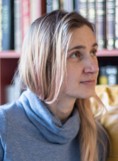
Olga Zvyeryeva was born in Kharkiv, Ukraine. She is a sociolinguist, holding a PhD in Germanic Languages. She authored two poetry collections and has won awards at international poetry festivals. Her poems have been published in anthologies and online in Ukraine, Russia, Germany, the Czech Republic, Israel, and the United States. She is an editor of the literary platform Tochka Zreniya.
Back: Mio Grand | Anna Krushelnitskaya ■ Next: Serge Shestakov | Maria Bloshteyn